
By Jeff Gallagher, founder of Made By Hemp. Helping people find real hemp since 2013.
When you are buying CBD oil for the first time, four things tell you most of what you need to know: where the hemp was grown, how the oil was extracted, whether an independent lab has tested it, and which product form fits your routine. This guide covers each one, defines the terms you will see on labels, and helps you settle on a product and a serving size without guesswork.
Made By Hemp has been selling hemp extracts since 2013, which means we have watched this market go from a handful of small brands to a crowded shelf where quality varies enormously. This guide is the short version of what we have learned about telling the two apart.
- Chapter 1: CBD 101, the basics of cannabidiol
- Chapter 2: CBD-related terminology
- Chapter 3: How to find quality CBD oil
- Chapter 4: Ways to take CBD
- Chapter 5: How much CBD to take
Take this guide with you. Too busy to read it now? Download the Made By Hemp Buyer’s Guide as a PDF.
Chapter 1: CBD 101, the basics of cannabidiol
What is CBD?
Cannabidiol, better known as CBD, is a compound found primarily in the cannabis plant. It has drawn a lot of attention over the past decade, alongside a growing body of published research into how cannabinoids interact with the body.
It helps to separate CBD from the 100-plus other compounds, known collectively as cannabinoids, found in cannabis and other plants. The only cannabinoid known to cause intoxicating effects is THC. CBD and the rest are considered non-intoxicating. For more, see the difference between CBD and THC.
Hemp varieties of cannabis contain 0.3% THC or less, which is nowhere near enough to cause an intoxicating effect. Marijuana is a cousin to hemp and is the variety bred for those effects. For more, see the difference between hemp and marijuana.
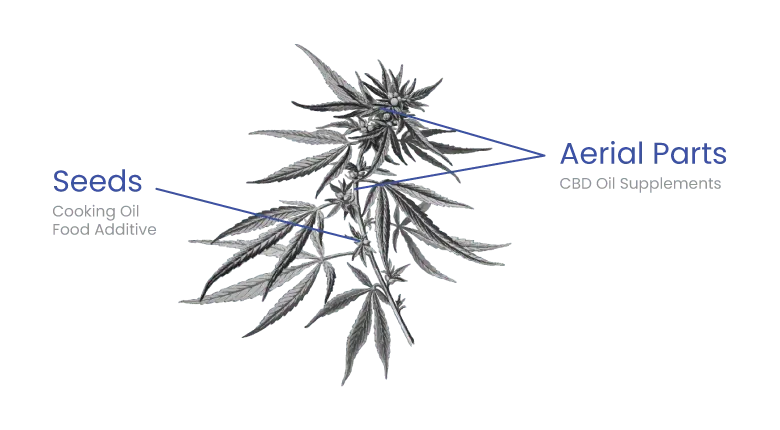
CBD oil comes from the aerial parts of the plant
CBD oil is extracted from the aerial parts of hemp, meaning the stalks and flowers, not the seeds. Hemp seed oil is a popular food ingredient with real nutritional value, but it contains no CBD. If a label says hemp seed oil, you are not buying CBD.
You can take CBD oil in its raw form, usually called a concentrate, or infused into another product. Chapter 4 covers each of those formats in turn.
Chapter 2: CBD-related terminology
CBD labels are full of jargon. Here are the terms you will run into, in alphabetical order, with an example of each where one helps.
Cannabidiol. A non-intoxicating cannabinoid of the cannabis plant, shortened to CBD. It is the compound this whole guide is about. More on what cannabidiol is.
Cannabinoid. A class of compounds that interact with the body’s own endocannabinoid system. They come in two kinds: phytocannabinoids, which come from plants, and endocannabinoids, which your body makes itself. Related compounds also turn up in dark chocolate, hops, and black pepper. More on cannabinoids.
Cannabis. A genus of flowering plants that includes three species: Cannabis sativa, Cannabis indica, and Cannabis ruderalis. Both hemp and marijuana are varieties of Cannabis sativa.
COA (certificate of analysis). The report showing what an independent lab actually found in the product. It is the single most useful document in this industry. Ours are published on our lab results page, and if you want to know how to read one, start with what a COA is and how to read it.
Concentrate. A concentrated form of hemp oil, extracted straight from the plant with no additives. Our raw hemp extract is an example.
Concentration. The amount of a substance contained within a given volume. Easy to confuse with the entry above it, and not the same thing.
Decarboxylation. A chemical reaction that uses heat to convert CBDa, the precursor compound, into CBD. It is what separates a raw oil from a decarboxylated one. More on the difference between raw, decarboxylated, and filtered hemp oil.
Edible. Food infused with CBD, such as a chocolate or a gummy. Our CBD gummies are an example.
Endocannabinoid. A cannabinoid your body produces on its own, rather than one that comes from a plant. Anandamide and 2-AG are the two best understood. They are what the body’s endocannabinoid system is named after, and they are the reason that system exists at all, entirely independent of whether you have ever touched hemp.
Extraction. The process of removing the cannabinoids and aromatic compounds of hemp from the plant material.
Hemp. A variety of the cannabis plant grown for industrial use. Hemp is low in THC and higher in CBD, so it is non-intoxicating. More on the difference between hemp and marijuana.
Hemp oil. Oil extracted from high-CBD, low-THC hemp. It can contain trace amounts of THC and is non-intoxicating. More on what hemp extract is.
Marijuana. A variety of the cannabis plant grown for THC content. It is high in THC and does cause intoxicating effects.
Phytocannabinoid. A cannabinoid that comes from a plant rather than from the body. CBD and THC are both phytocannabinoids.
Potency. How much CBD is in a product, usually stated in milligrams.
Sublingual. Held underneath the tongue, which is how tinctures and concentrates are taken. More on how to take hemp oil.
Terpenes. The compounds responsible for the aroma and flavor of hemp. They are why one batch can smell and taste different from the next. More on terpenes.
Tetrahydrocannabinol. The main intoxicating cannabinoid of the cannabis plant, shortened to THC. Hemp contains 0.3% THC or less, which is not enough to cause an intoxicating effect. More on the difference between CBD and THC.
Tincture. A hemp-infused liquid with a dropper or spray top, taken under the tongue. Our Hemp Extract Tincture is an example.
Topical. A product applied to the skin, such as a lotion, serum, or salve. Our Cooling Muscle Rub is an example.
Chapter 3: How to find quality CBD oil
Start with a reputable seller
Before you buy, confirm that the place you are buying from is legitimate. As the CBD market has grown, so has the number of sellers cutting corners. You can avoid most bad sources by checking for the three things below.
Sourced from quality hemp
Where the hemp was grown is a real indicator of quality. Hemp is a bioaccumulator, which means it draws material up out of the soil. That is useful for remediating land, but it also means the plant takes up whatever chemicals were used while it was growing. Look for oil sourced from hemp grown without chemical fertilizers, herbicides, or pesticides.
Farmer experience matters too. Many reputable brands source from Europe, where growers have decades of experience with hemp in their climate and standards are high. As more American farms come online we expect to see more domestic sourcing, but Europe set the bar.
Extracted using a clean method
Hemp oil can be extracted several ways, and they are not equal. The highest standard is CO2 extraction, where the plant material is put under high pressure at low temperature. It is a complex and expensive process, but it removes the need for harsh chemicals.
Some producers instead use solvents such as butane or ethanol. It works, but it also strips out the plant waxes that we think are worth keeping in the finished oil.
Tested by an independent lab
Hemp oil should be tested regularly to confirm its potency and check for impurities. Testing verifies that the amount of CBD on the label is actually in the bottle, and that the legal THC limit of 0.3% has not been exceeded. A company that tests consistently and publishes the results is showing you its work.
Those results come as a COA, or certificate of analysis. A reputable seller will have a recent one available to anyone who asks. We publish COAs for every product we carry on our lab results page and on each product page. If you want to know how to actually read one, we wrote a guide: what a COA is and how to read it.
Find reputable CBD at Made By Hemp
We have been doing this since 2013. Every brand we carry was chosen for quality and integrity, and we give you easy access to the lab results for all of it. If a product cannot show its work, we do not put it on the shelf.
Chapter 4: Ways to take CBD
Find the form that fits you
Once you have found a source you trust, the next decision is which type of product you want. CBD oil is versatile. It can be taken as it comes or infused into all sorts of formats, and the right one depends on how you want to take it, how quickly you want it to absorb, and which base you prefer.
The base of a CBD product is usually either a whole plant hemp extract or a CBD isolate. A whole plant extract carries the full range of the plant’s cannabinoids, while an isolate contains CBD only. In practice this comes down to whether you want a broad spectrum product with the THC removed, or a full spectrum one containing the legal trace amount of 0.3% THC or less. Either way, both are non-intoxicating. For more, see full spectrum, broad spectrum, isolate, or PCR: which is best?

CBD hemp oil concentrates
Potency: high
Taste: earthy
Use: sublingual
Concentrates are the most direct format. A thick oil extracted straight from the hemp plant with nothing added, taken sublingually, meaning held under the tongue and then swallowed. Because there is no carrier oil diluting it, a concentrate is the most cannabinoid-rich thing on the shelf, and it tastes like it. We carry ours in two versions.
Green. Also called the raw version. Extracted without heat or filtering, so it stays a full spectrum whole plant oil carrying a mix of cannabinoids, primarily CBD and CBDa, along with the plant’s terpenes.
Blue. Decarboxylated, which converts the CBDa into CBD.
Because a concentrate is held under the tongue, it absorbs faster than something you swallow. If you want the least processed form of the plant we sell, this is it.

CBD capsules and softgels
Potency: medium to high
Taste: none
Use: oral
Capsules are swallowed, which makes them the most familiar format on this list and the easiest to fold into a routine you already have. They travel well, there is no measuring, and because you swallow them there is no hemp aftertaste.
Since a capsule goes through the digestive system, it takes longer to absorb than something held under the tongue. That is the tradeoff: convenience and no taste, in exchange for a slower release.

CBD tinctures
Potency: low to high
Taste: earthy to delicious
Use: sublingual
A tincture is hemp oil in a liquid carrier such as coconut or grapeseed oil, which thins the consistency and softens the taste. Like a concentrate it goes under the tongue, but it arrives in a bottle with a dropper or spray top, so it is far easier to work with.
Tinctures are the format most people start with, and for good reason. They come in a range of strengths and flavors, they are easy to take if you struggle with pills, and being sublingual they absorb quickly. If the taste of raw hemp is what has been putting you off, start here.

CBD skincare and topicals
Potency: low to high
Taste: please do not eat it
Use: topical
Topicals are anything you apply to the skin: serums, lotions, salves, lip balms. You massage the product into a specific area rather than taking it internally, so it works differently from everything else on this list. CBD applied this way is absorbed into the skin and does not enter the bloodstream.
Our skincare is made with simple ingredients that moisturize and nourish, and hemp oil brings along vitamins, minerals, proteins, and fatty acids of its own.

CBD edibles
Potency: low to high
Taste: delicious
Use: oral
Edibles are treats infused with CBD: gummies, chocolate, gum. They tend to come in smaller amounts of CBD per piece, which is exactly why they are so popular with people trying CBD for the first time. They also look like an ordinary snack, so they are a discreet way to take it.
Just mind the serving size on the packaging, because they taste like candy and it is easy to forget they are not.
Chapter 5: How much CBD to take
How much CBD should I take?
There is no standard amount of CBD that everyone should take. The right serving size varies from person to person, and finding yours starts as trial and error. We are not doctors and we cannot tell you what to take, but we can tell you how people generally go about working it out.
Start with potency
Potency is the concentration of CBD in a product. Once you have picked a format, you still have to pick a strength, and that is worth a conversation with your physician rather than a guess.
As a rough map: edibles and lower-strength capsules sit at the gentle end and are a common starting point. Tinctures and capsules cover the broad middle and are easy to adjust. Concentrates are the high end.
Then find your serving size
Start with the serving size the manufacturer recommends and treat it as a baseline. Stay with it for a week, then check in with yourself. If it is not doing what you hoped, increase the serving and give it another week. Repeat until you land somewhere that feels right. The pattern that works is start low, stay consistent, and change one thing at a time.
If you are pregnant, nursing, or taking medication, talk with your healthcare provider before adding hemp oil to your routine. For a fuller walkthrough of servings and milligram math, see our guide on how to take hemp oil.
Set a budget
For most people CBD becomes a recurring purchase, so it is worth deciding up front what you want to spend. Price and value are not the same thing. A more expensive product can be the better value depending on how much CBD is actually in it.
Three questions make the comparison easy. How much CBD do you want to take per day? How many servings does the product contain? What does each serving therefore cost? Run that math and the shelf gets a lot easier to read. The good news is that CBD prices have fallen a long way over the past several years as more farmers have started growing hemp.
Still have questions?
Choosing your first CBD product can be confusing, and we would rather talk it through than have you guess. Made By Hemp has been helping people find real hemp since 2013. Call (844) 887-4367, email support@madebyhemp.com, or use the chat box in the corner. Our West Michigan team is around Monday to Friday, 9 to 5 Eastern.
These statements have not been evaluated by the Food and Drug Administration. These products are not intended to diagnose, treat, cure, or prevent any disease.